

Agentic AI represents a new generation of artificial intelligence that goes beyond scripted interactions. In this article, we unpack what agentic AI is, how it powers more intelligent chatbots, and why it enables brands to move past rigid, rule-based conversations toward more natural, effective customer engagement.
Derived from the word “agent,” agentic AI refers to systems designed to act autonomously in the real world. These AI agents can make decisions, take actions, and work toward defined goals with minimal human intervention.
Unlike traditional AI models, agentic systems are capable of managing complex, multi-step workflows. They can plan, reason, and execute tasks end-to-end – bridging the gap between decision-making and execution. The result is more meaningful, conversational support that adapts to customer needs in real time.
Together, these capabilities enable customer experiences that feel less scripted – and far more human.
How Does Agentic AI Work?
Agentic AI follows a structured yet flexible process that enables it to make intelligent decisions independently. Unlike traditional systems that rely on predefined rules and scripted responses, agentic AI uses autonomous reasoning to understand issues, prioritise actions, and determine the most effective path to resolution.
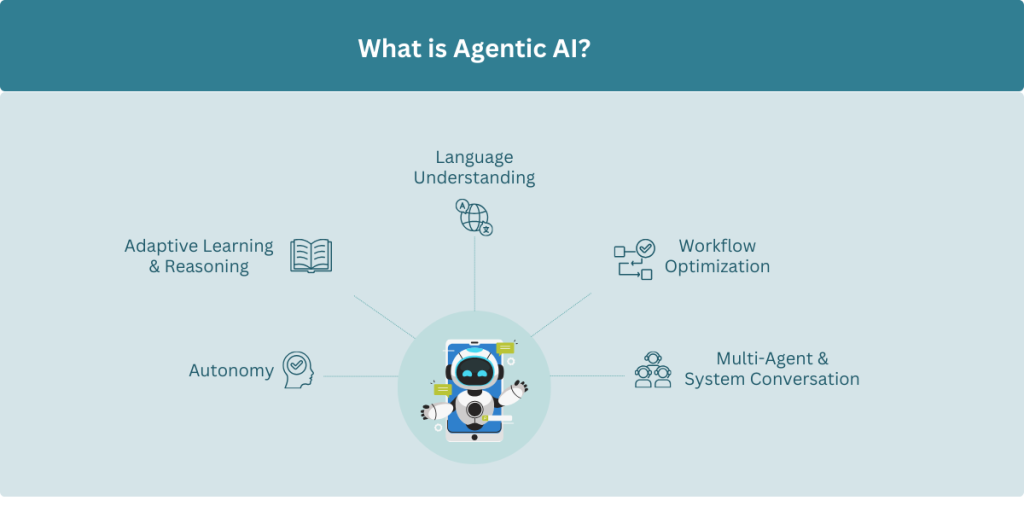
Rather than simply simulating conversation, agentic AI actively evaluates context, assesses intent, and decides what to do next – whether that’s gathering more information, triggering a workflow, or resolving an issue end to end.
At first glance, this approach may sound complex. Let’s simplify it with a practical example. Imagine a customer contacting support with a technical issue. Instead of escalating the ticket to a human agent, agentic AI can analyse the problem, plan the required steps, and take action to resolve the issue autonomously – delivering faster, more accurate support without human intervention.
1. Draws On A Rich Range Of Data Sources
Agentic AI begins by gathering information from multiple data sources to build context and make informed decisions. Rather than relying on isolated inputs, it connects the dots across systems to understand the full picture.
These data sources can include:
- Databases and APIs
- Customer data, such as behavioural insights and conversation history
- User prompts and real-time inputs
Example: A customer contacts support about trouble connecting their new earbuds to their smartphone. Instead of simply reacting to a keyword, agentic AI draws on the customer’s purchase history, product specifications, and troubleshooting documentation. With this broader context, it can independently determine whether the issue is likely caused by a known software bug or a potential hardware fault – and take the appropriate next steps.
2. Connects Customers To Role-Based AI Agents
Agentic AI intelligently determines the most appropriate service path for each customer interaction. Based on the issue at hand, it can route customers to specialised AI agents or guide them through targeted message flows designed to resolve specific problems efficiently.
Depending on the configuration, brands may deploy multiple customer service chatbots, each focused on a distinct use case, such as:
- General customer support
- Device diagnostics
- Troubleshooting and self-service
Example: When a customer reports an issue with their smartphone or smartwatch, agentic AI can seamlessly route them to a troubleshooting agent that provides clear, step-by-step instructions – such as how to safely reboot the device – without unnecessary handovers or delays.
3. Evaluates And Recommends The Best Option
Using advanced algorithms, agentic AI evaluates all available data to determine the most effective course of action. Unlike static decision trees, it uses self-directed reasoning to adapt and respond to each unique situation.
Key capabilities include:
- Adapting to new or changing information
- Running predictive models
- Assess risks and benefits
Example: If a customer is experiencing connectivity issues with their devices, agentic AI might determine that restarting both devices resolves the problem in 90% of cases. But it doesn’t stop there – if the first step doesn’t work, the AI adjusts its approach and follows a secondary plan automatically, all without needing additional input from a human agent.
4. Takes Action When Authorized
Agentic AI always respects approval mechanisms before taking critical steps. Once authorized, however, it can act independently to achieve the desired outcome – such as processing a replacement – while still following predefined rules and escalation protocols.
Key safeguards include:
- Manual approval for key actions
- Automated responses triggered by predefined rules
- Escalation to a human agent when needed
Example: If troubleshooting doesn’t resolve the issue, agentic AI can determine that a device is faulty and offer a warranty replacement. It can generate a return label and seamlessly guide the customer to a support chatbot that helps complete the replacement process – ensuring a fast, frictionless experience without waiting for human intervention.
In situations like this, a human agent would normally step in once a troubleshooting chatbot couldn’t resolve the issue. Agentic AI, however, goes beyond simply responding to customer queries – it actively works to solve problems. By autonomously handling complex tasks, it’s transforming the brand-to-customer experience, delivering faster resolutions and seamless support on behalf of both the user and the brand.
.
Agentic AI vs. Generative AI
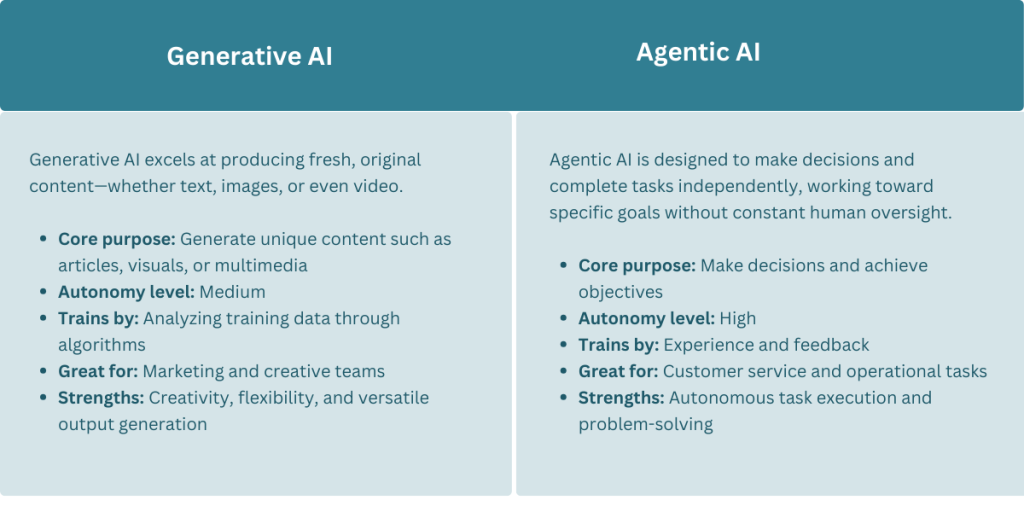
AI terminology can be overwhelming, with new tools and buzzwords appearing constantly. For brands, the challenge is knowing which technology to use – and when. Generative AI is one of the most well-known AI tools, but how does it differ from agentic AI, and what unique benefits does each bring to the table?
Agentic AI vs. Rule-Based Chatbots
While generative AI shines in creative tasks, administrative problem-solving in customer service requires a different approach. Traditionally, brands have relied on rule-based chatbots to handle customer queries. These systems can be useful for simple tasks, but they often fall short when it comes to delivering a seamless, effortless customer experience.
Let’s take a closer look at how agentic AI compares to traditional chatbots in the world of customer service.
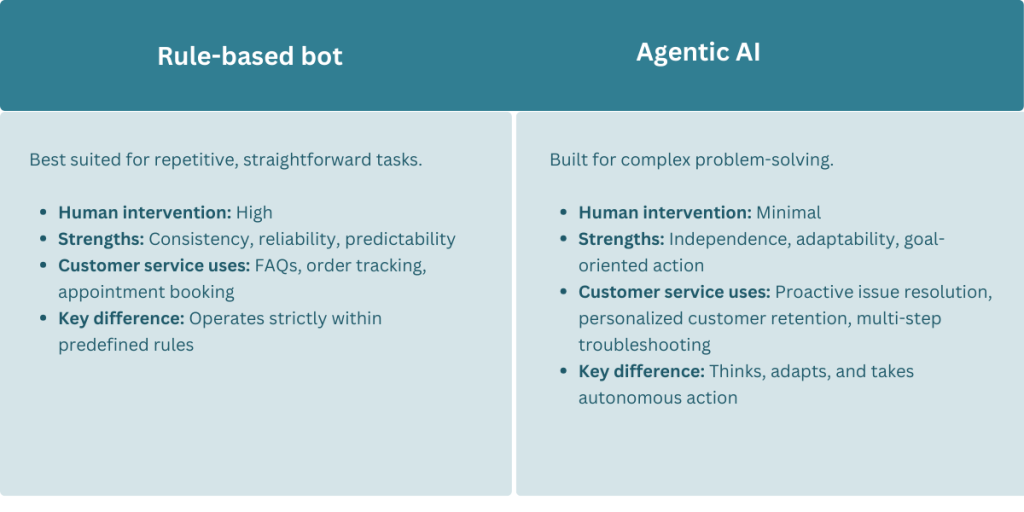
Traditional chatbots work well for simple, straightforward tasks – but agentic AI takes the customer experience to a whole new level. Acting as an autonomous decision engine, it understands how to achieve goals independently, adapting its actions to each situation. For brands, this means moving up the Conversational CX Maturity ladder – relying on AI assistants to handle complex interactions while delivering seamless, effortless experiences for customers.
.
Benefits Of Agentic AI
Agentic AI delivers measurable value for both enterprise organisations and mid-sized businesses.
For enterprises, the value is clear:
- Elevated customer experience: AI agents deliver consistent, personalised interactions at scale – driving higher customer satisfaction, loyalty, and long-term retention.
- Lower operational costs: By automating complex workflows, organisations reduce reliance on human agents while improving efficiency and cost control.
- Built-in compliance and data residency: A robust AI infrastructure ensures data is processed within compliant, regional data centres, meeting even the most stringent regulatory standards.
For medium-sized businesses, Agentic AI delivers practical advantages:
- Scalable growth without added overheads: Provide 24/7 customer support and handle increasing demand without expanding teams or infrastructure.
- Higher productivity: Automation removes repetitive tasks, freeing teams to focus on higher-value, strategic work.
- Rapid deployment: Turnkey, configurable AI solutions enable rapid deployment of intelligent FAQs, lead qualification, and conversational commerce experiences.
.
Use Cases For Agentic AI
Troubleshooting
To minimize customer effort and accelerate resolution, Agentic AI can rapidly identify technical issues and recommend solutions using input and contextual data. It can also triage support tickets, directing them to the most appropriate AI chatbot or human agent, ensuring faster and more accurate technical support.
Proactive support
Agentic AI helps brands stay one step ahead by spotting potential issues – such as delayed deliveries, network disruptions, or inactive customers at risk of churn – before they impact the business.
Warranty and claims submission
Agentic AI can streamline warranty and claims processes by guiding customers step-by-step, reducing the burden on human agents, and ensuring that insurance claims or warranty submissions are completed accurately and efficiently.
Personalized retention
To maintain customer engagement and loyalty, brands can create personalized retention campaigns that invite real interaction. For example, a streaming service AI might detect a subscriber hasn’t used their account in months and proactively offer a tailored discount or content recommendations based on their viewing history.
Order modifications
Sometimes customers need to modify their orders or adjust delivery details after purchase. With Agentic AI, customers can make these requests directly through chat, receiving instant confirmations when updates are processed – reducing repetitive tasks for call centre agents and improving the overall customer experience.
Conversational commerce
AI agents can use conversational commerce to create highly personalized shopping experiences. By understanding each customer through their data, they can proactively recommend products, guide users through the purchase process, and even complete transactions seamlessly.
.
Challenges Around Agentic AI Implementation
As with any AI technology, there are risks and challenges that must be carefully managed to ensure customers receive the safest, most reliable, and high-quality experiences.
Autonomy
Autonomous decision-making is a key strength of Agentic AI – but it also presents challenges. Like other AI solutions, it can sometimes produce errors or “hallucinations.” The solution is to strike the right balance between AI and human oversight, ensuring a human is always in the loop to monitor decisions and maintain accuracy.
Privacy
Agentic AI relies on large volumes of data, including sensitive customer information. To protect privacy, brands must prioritise data safeguards and responsible usage in their AI strategy. The solution is to partner with an experienced AI provider that understands communication compliance, ensuring all interactions meet regional regulatory requirements.
Integration
Many brands rely on a mix of platforms and legacy systems to manage customer communications, which can make AI integration challenging. The solution is to gradually modernize infrastructure with AI-friendly platforms and partner with providers that offer robust support for seamless integration.
User trust
Customers can sometimes be hesitant to interact with AI chatbots, unsure whether their issues are being addressed or if their information is secure. The solution is to train AI to provide clear, transparent responses that instil confidence, while always offering the option to connect with a human agent to build trust and ensure a positive experience.
.
What Could The Future Of Customer Experience Look Like With Agentic AI?
We’re already living in a future that arrived faster than many anticipated. AI can think, make autonomous decisions, and understand human language, intent, and emotion. But intelligent AI agents are just the beginning. The evolution of Agentic AI is expected to continue, shaping customer experiences in exciting new ways.
Explainable AI (XAI)
To address user hesitation around interacting with intelligent AI agents, explainable AI (XAI) can be a game changer. As AI takes on more responsibility, transparency becomes essential. XAI allows AI agents to provide clear, understandable explanations for their decisions.
For example, a banking AI might reject a loan application but explain: “Your credit utilization is 75%, which exceeds the approval threshold of 40%.” This level of transparency builds trust, alleviates bias concerns, and ensures customers understand the reasoning behind AI-driven decisions.
Self-optimization
Agentic AI can already learn from experience and feedback, but the future lies in self-optimizing responses. Imagine an AI that identifies points in a conversation where multiple customers disengage, determines the cause, and automatically adjusts its flow or responses to improve the experience – all without human intervention. This level of adaptability promises smarter, more seamless customer interactions.
Superapp collaboration
Superapps make it easier for brands to engage customers by offering a one-stop shop for all their needs. Agentic AI can enhance the customer journey within these platforms. For example, a customer orders pizza through a superapp on a Saturday night, while having been inactive on their streaming service for weeks. Agentic AI can push a personalized notification within the same superapp, alerting them to a new release they might enjoy based on their viewing history. In this way, Agentic AI enables seamless cross-platform collaboration and personalization, leveraging the growing popularity of superapps to create smarter, more connected experiences.